

Overview of Maldivian Old Culture
1. Origins and Influences
Maldivian culture has roots in South Indian, Sinhalese, Arab, African, and Southeast Asian traditions. This blend is a result of the Maldives’ position as a key stop on ancient maritime trade routes in the Indian Ocean.
Religion and Beliefs
-
Pre-Islamic Era: Before converting to Islam in 1153 AD, Maldivians practiced a mix of Buddhism and Hinduism, evident in archaeological remains such as Buddhist stupas, statues, and temple ruins found in islands like Gan (Laamu Atoll) and Fua Mulah.
-
Post-1153 AD: After the conversion to Islam, Islamic values and practices became central to Maldivian identity, influencing everything from law and education to daily life and architecture.
Traditional Clothing
-
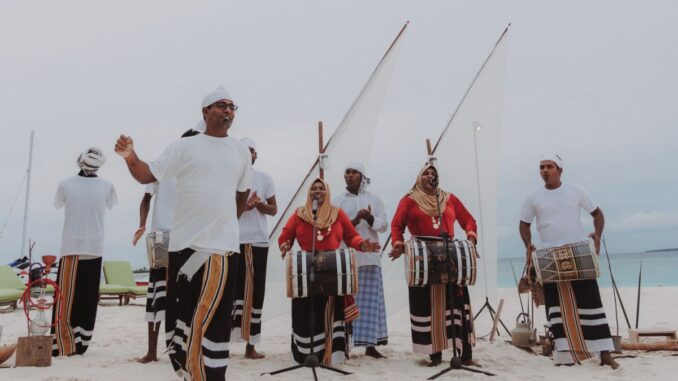
Men: Traditionally wore a sarong (called feyli) with a white shirt. A gold-threaded feyli was worn for special occasions.
-
Women: Wore the “libaas”, a long dress with intricate embroidery, often complemented with gold jewelry.
Music and Dance
-
Bodu Beru: A central element of Maldivian culture, this traditional music and dance performance uses drums, singing, and rhythmic dancing, introduced via East African influence.
-
Thaara: A form of Islamic devotional music, performed by men in rows, brought by Arab traders.
-
Dhandi Jehun: A dance involving sticks, similar to South Asian folk traditions.
Architecture and Craftsmanship
-
Coral Stone Buildings: Many early mosques, such as the Hukuru Miskiy (Friday Mosque in Malé), were built with carved coral stone — a unique and intricate art form.
-
Lacquer Work and Mat Weaving: Skilled handcrafts like wood lacquer (liye laajehun) and reed mat weaving (kunaa) from G.Dh. Gaddhoo are prized cultural products.
Language and Literature
-
Dhivehi Language: An Indo-Aryan language with its own unique script called Thaana, which is written right-to-left.
-
Oral Traditions: Folk tales (kurevi) and legends were passed down orally. Stories often included sea spirits, jinn, and heroic seafarers.
Seafaring Life
-
Traditionally, Maldivians were fisherfolk, sailors, and boat builders. The dhoni, a wooden boat, is iconic in Maldivian history and craftsmanship.
-
Fishing and coconut-based subsistence formed the core of rural island life.
Social Structure and Governance
-
Before modernization, society was organized under a sultanate system, with a royal court, nobility, and local island chiefs.
-
The Sultanate of Maldives lasted until 1968, when the country became a republic.
Festivals and Rituals
-
Maahefun: Celebrated before Ramadan begins, with food, music, and gatherings.
-
Eid Celebrations: Traditional games, feasts, and community bodu beru performances are central.
-
Old rituals for rainmaking, healing, and protection against spirits also existed but diminished with increased Islamic influence.
Cultural Preservation Today
Modernization and tourism have transformed the Maldives rapidly, but efforts are being made to preserve old traditions through:
-
Cultural festivals
-
Heritage conservation projects
-
Education and museum exhibits, such as the National Museum in Malé