

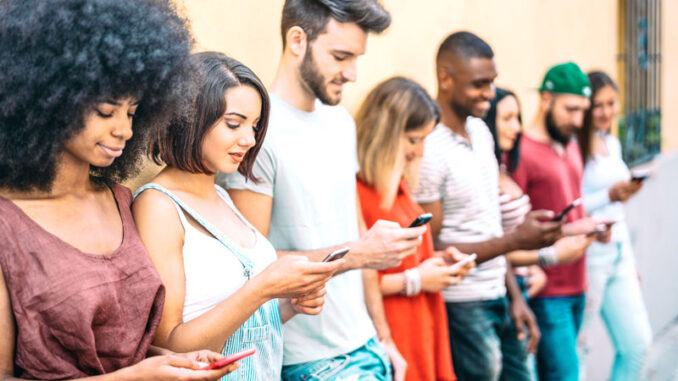
Every generation fears the next technological revolution.
Today, the debate centres on social media. Governments, including the United Kingdom, are considering stricter rules to limit young people’s access to platforms such as TikTok, Instagram and YouTube. Their concerns are understandable. Parents worry about addiction, cyberbullying, harmful content and the mental health of their children.
But history teaches us an important lesson.
When society fears a new technology, the first reaction is often to resist it rather than understand it.
History Repeats Itself
Britain, the birthplace of the Industrial Revolution, experienced fierce resistance whenever new machines transformed society.
When mechanised textile machines were introduced, thousands of workers believed they would lose their livelihoods. The famous Luddites smashed machinery in factories because they feared that technology would replace human labour. Society fought against change before eventually embracing it.
The sewing machine also faced strong opposition when it transformed the clothing industry. Many tailors feared it would destroy traditional craftsmanship and eliminate jobs. Yet today, no one questions whether the sewing machine made the world more productive.
Electricity faced similar scepticism. Many households were reluctant to replace traditional oil lamps, believing familiar methods were safer and more reliable. Over time, electricity became one of humanity’s greatest achievements.
Every technological revolution has been accompanied by fear.
Social media is simply the latest chapter.
We Are Judging Social Media by Its Worst Content
Ask many adults what they think of TikTok, and the answer is often the same:
“Dancing videos.”
But that view ignores millions of creators who teach valuable skills every single day.
A teenager can learn:
- Artificial Intelligence
- Software development
- Robotics
- Engineering
- Graphic design
- Digital marketing
- Business strategy
- Video production
- Foreign languages
- Mathematics
- Science
For many young people, social media has become the world’s largest free classroom.
Never before in history has a child living on a small island, in a rural village or in a developing country had access to experts from the world’s leading universities, technology companies and businesses—completely free of charge.
Knowledge that once required expensive education is now available on a mobile phone.
The Algorithm Doesn’t Control You—You Train It
One of the biggest misunderstandings about social media is the algorithm.
People often believe that platforms decide what children watch.
That is only partly true.
Algorithms learn from human behaviour.
Watch entertainment all day, and more entertainment appears.
Watch AI tutorials, coding lessons, engineering projects, science experiments and business education, and the algorithm begins recommending more educational content.
The algorithm is constantly learning from its user.
In many ways, we design our own digital world through the choices we make.
The Real Problem Is Not Social Media
The real problem is that we have never taught children how algorithms work.
Schools teach mathematics.
They teach science.
They teach history.
But very few teach digital intelligence.
Imagine if every child understood how recommendation systems work.
Imagine if parents showed their children how to build an educational feed by following scientists, innovators, software developers, entrepreneurs and engineers instead of simply consuming endless entertainment.
The same platform that distracts one child could inspire another to build the next breakthrough in Artificial Intelligence.
Don’t Ban the Tool—Teach People to Use It
We do not ban books because some contain poor information.
We do not ban televisions because some programmes lack educational value.
We do not ban electricity because it can be dangerous if used carelessly.
Instead, we educate people to use these tools responsibly.
Social media should be no different.
Children need guidance, age-appropriate protections and healthy limits. Parents should monitor online activity, encourage critical thinking and help children distinguish reliable information from misinformation.
The answer is education—not prohibition.
Preparing the Next Generation
The future belongs to those who understand technology.
Tomorrow’s innovators, engineers, entrepreneurs and scientists are already learning online today.
Artificial Intelligence, robotics and digital businesses will shape the world’s economy for decades to come.
If we deny young people access to these learning opportunities without teaching them how to use them wisely, we risk preparing them for yesterday’s world instead of tomorrow’s.
A Better Question
Perhaps society is asking the wrong question.
Instead of asking,
“How do we stop children from using social media?”
We should ask,
“How do we teach children to train their algorithms, filter out distractions and turn social media into the greatest learning platform ever created?”
Technology itself is neither good nor bad.
Its impact depends on the knowledge, discipline and purpose of the person using it.
The next generation does not need less technology.
It needs better digital education.
Because the future will not be built by those who fear technology.
It will be built by those who learn to master it.